
Multi-Specialty Group: 92 Clinicians, 3.1 Hours Saved Daily

3.1 hours per provider returned daily through ambient AI deployment
Business Challenges
a 92-clinician multi-specialty group across the Pacific Northwest arrived at the engagement with a stack of pressures that compounded each other. Each problem was independently solvable, but collectively they were producing margin compression and operational drag that leadership knew it could not let drift further.
- Providers averaged 3.1 hours of pajama-time charting per night, with internal-medicine and primary-care leading the burden curve.
- Three providers had given written notice citing documentation workload as the primary factor.
- Specialty templates were inconsistent across the 8 specialties, causing downstream coding rework on 22% of encounters.
- Encounter throughput was capped by chart completion, leaving 14% of urgent same-day requests routed to urgent care.
- Quality measure attribution suffered as structured fields were inconsistently populated.
Before vendor selection began, leadership wrote down what would constitute a successful engagement. Those success criteria — measurable on day one — shaped every conversation that followed.
Solution
eCareScribe was selected as the ambient AI medical scribe for the engagement. The decision rested on three things: ambient AI that listens during patient encounters and generates structured clinical documentation; a deployment playbook tuned to the specific workflows on the table; and a partner team willing to commit to outcome targets rather than scope-of-work milestones.
The proposed solution centered on the eCareScribe platform pillars that mapped directly to the documented pain: ambient capture, structured note generation, and specialty templates. Each pillar was paired with a measurable KPI (documentation time, after-hours charting, encounters per provider) so the engagement would be steerable on quantitative signals, not impressions.
Value Delivered
By the end of the 90-day window leadership had set, every primary success criterion had moved into the target band. The headline outcomes:
- 3.1 hours — saved per provider per day
- +22% — patient throughput across the group
- 0 → 3 — providers who stayed (all original noticers retracted)
- 96.4% — first-pass coding accuracy on AI-drafted notes
- 4.9 / 5 — clinician NPS on the platform
What mattered more than any single number was that the metrics moved together. Improvement in one KPI did not come at the expense of another. Clinical, operational, and financial signals all trended in the same direction — the marker of a structural fix rather than a one-off optimization.
Solution Provided
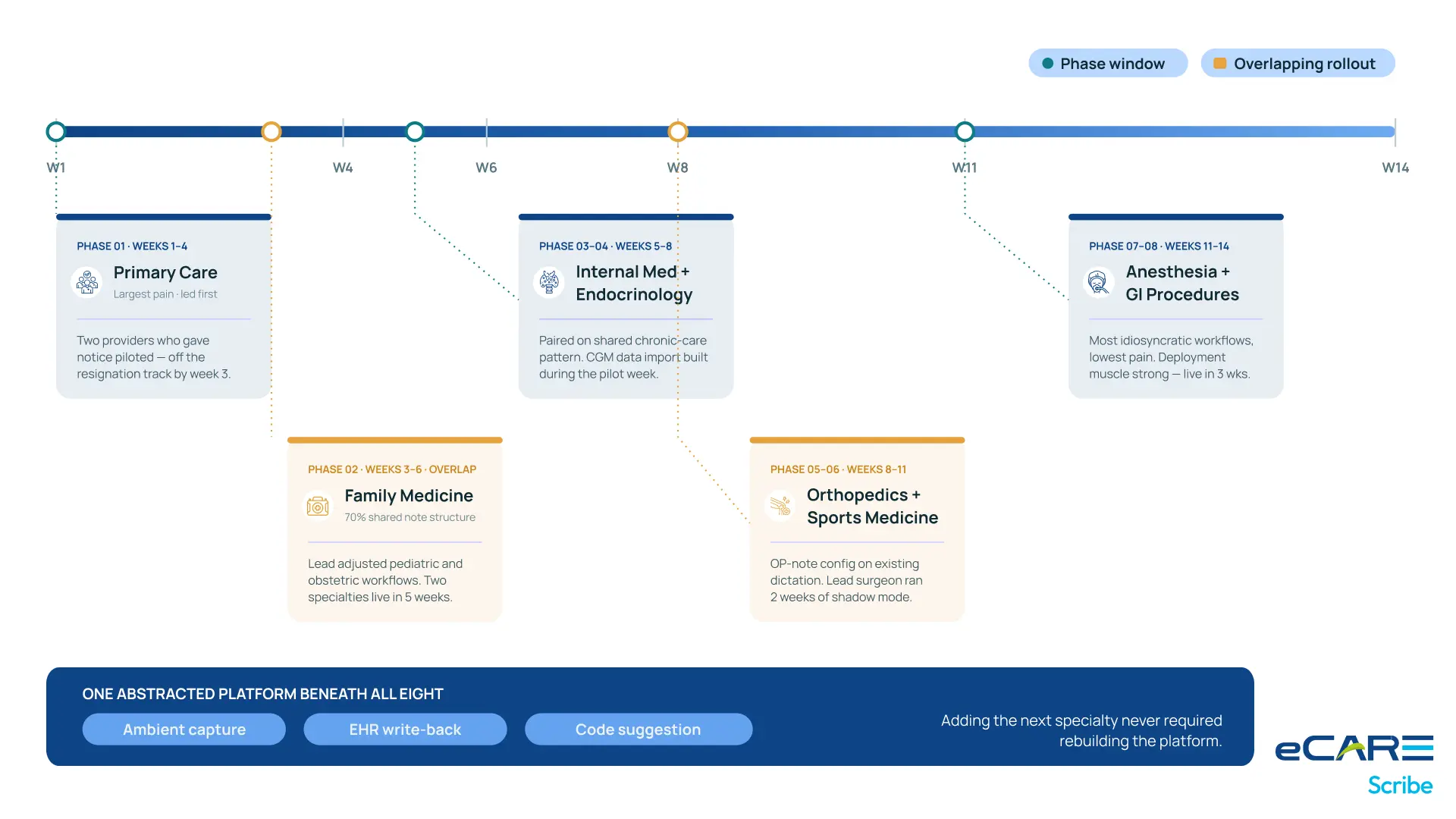
The eCareScribe deployment followed a three-phase plan executed over 12 weeks.
Phase 1: Discovery + Baseline Instrumentation (Weeks 1–3)
No configuration choice was made until the baseline was instrumented. Source systems were connected, current-state metrics (documentation time, after-hours charting, clinician satisfaction) were captured live, and the leadership team got a shared dashboard against which every later decision would be measured.
Phase 2: Pilot + Iteration (Weeks 4–7)
A pilot group representing the realistic operational range — including operational skeptics — was onboarded. Every week, a structured feedback loop with the pilot users surfaced workflow friction; configuration was tuned before scale-out, not after. The pilot validated the ambient capture and structured note generation workflows under real conditions.
Phase 3: Scale + Operational Handover (Weeks 8–12)
The platform was extended to the full user base in two waves to keep the support load manageable. eCareScribe's operational team co-piloted with the customer team through go-live, then formally handed over operational ownership. The post-deployment review codified ownership, escalation paths, and the quarterly optimization cadence.
Three specific capabilities did the work: specialty templates closed the documentation gap, EHR integration made the operational signal visible to leadership, and clinician control took the manual coordination overhead off the front-line team.
Business Value
Financial Impact
Direct revenue lift and cost reduction together exceeded the implementation investment by a margin that funded a second wave of work. The savings recurred — they were not one-off accounting wins but ongoing operational improvements with monthly compounding.
Workforce Impact
The teams using eCareScribe reported lower friction in their day-to-day work. Retention metrics improved alongside productivity metrics — a pattern that historically rarely co-occurs and indicates the platform reduced burden rather than redistributing it.
Strategic Impact
Leadership gained operational visibility that had not previously existed. The clinician satisfaction and first-pass coding accuracy metrics became weekly leadership reviews rather than quarterly fire drills. Capital allocation discussions moved from "where is the leakage?" to "where is the next dollar of growth?" — a meaningful change in how the organization talked about itself.
What replicates
The engagement succeeded because three elements were present: leadership set quantitative targets before vendor selection; the deployment ran a real pilot with real skeptics; and the partner team stayed engaged through the 90-day post-deployment review. Teams evaluating eCareScribe should plan for the same three elements — they are what convert a software deployment into a business outcome.