
Ambient AI Scribe ROI: The 2026 Deep Dive

Ambient AI has been in talks in healthcare circles for a while now. Ever since the introduction of AI and its applications with respect to easing work and reshifting the focus back to patient care, you might even think that the hype is real.
However, for someone who will invest in this technology, you must ask yourself this question, ‘Is it worth it?’
Well, this new technology promises to save time, improve efficiency of clinical and non-clinical staff and reduce administrative burden by a huge margin. Having said that, the challenge that still remains is whether these benefits can turn these transcriptions into real results that can impact the lives of your providers, patients and practice as a whole.
Now, many people think that the ROI of ambient AI scribes, like eCareScribe, they generally think about documentation time. While saving providers hours of charting every week is indeed something they are looking for, that’s just a part of the big picture. The impact is much deeper impacting different aspects of your practice from clinician satisfaction, patient access, documentation quality and overall operational performance.
The truth is that the ROI of ambient AI scribes can’t be measured with a single metric, it can be measured by a combined effect it has on every aspect of your practice.
On that note, let’s explore four key areas where healthcare organizations typically see the greatest return on investment and discuss how to evaluate the long-term impact of ambient AI scribe technology.
The 4 ROI Levers (And How to Measure Each)
When evaluating the ROI of an ambient AI scribe, most healthcare organizations focus on documentation time savings. While that's an important benefit, it only tells part of the story.
The real value often extends beyond efficiency gains. An AI scribe can influence provider satisfaction, patient throughput, documentation quality, and overall financial performance. Looking at these outcomes together provides a more accurate picture of long-term ROI.
A practical way to measure success is through four key ROI levers: clinician retention, patient throughput, documentation quality, and total economic impact. Each contributes value differently, but together they help healthcare organizations understand the broader impact of ambient AI.
Before implementation, establish baseline metrics such as documentation time, patient volume, after-hours charting, and provider satisfaction. These benchmarks make it easier to measure improvements and identify where the greatest value is being created.
Let's explore each of these ROI drivers and how healthcare organizations can evaluate their impact over time.
Clinician Satisfaction → Retention Math
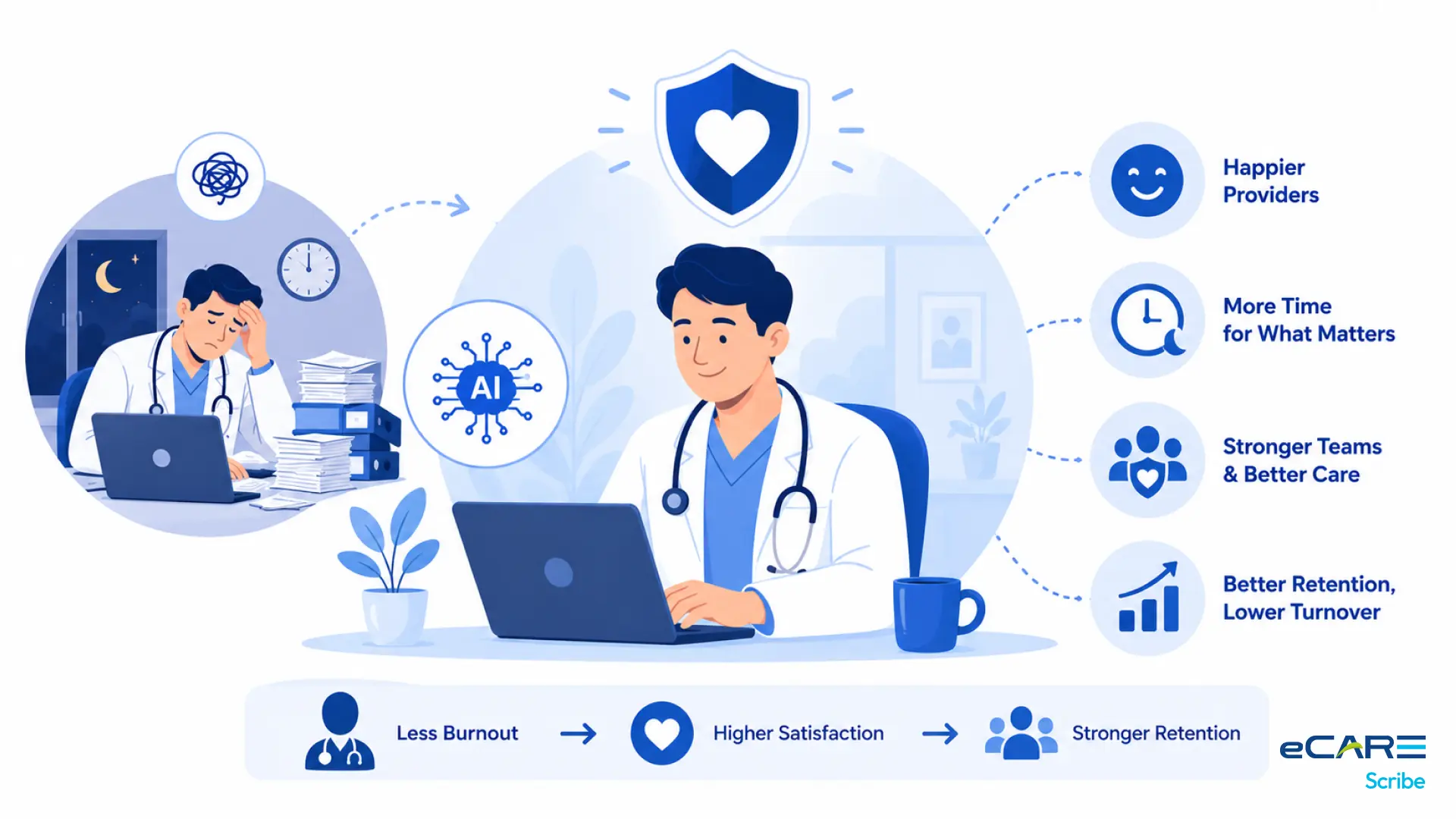
When healthcare leaders evaluate the ROI of an ambient AI scribe, retention is often overlooked because it isn't as easy to measure as time saved or revenue generated. Yet for many organizations, it can be one of the most valuable long-term benefits.
A major contributor to physician burnout is the amount of time spent on documentation outside of patient visits. Many providers continue charting after clinic hours—a phenomenon commonly known as “pajama time.” Over time, this administrative burden can affect job satisfaction, work-life balance, and overall engagement.
By reducing the effort required to create clinical notes, ambient AI scribes help providers spend less time documenting and more time focusing on patient care. The result is often a better provider experience and a more sustainable clinical workload.
This matters because provider turnover is expensive. Recruiting, onboarding, and replacing a physician can cost healthcare organizations significant time and resources, while also disrupting patient continuity and team productivity.
To understand the impact of this ROI lever, organizations should track metrics such as provider satisfaction, after-hours charting time, turnover rates, and retention trends. While the benefits may take time to emerge, even small improvements in clinician retention can create meaningful value over the long term.
Throughput → Revenue Math
Beyond reducing documentation burden, ambient AI scribes can also help healthcare organizations improve provider throughput. When clinicians spend less time creating notes, they often gain more flexibility in their schedules and workflows.
In many practices, documentation acts as a bottleneck. Adding more patient appointments often means more charting, more administrative work, and longer days for providers. By streamlining documentation, ambient AI scribes help remove some of that friction and create opportunities for greater efficiency.
Even small improvements can make a noticeable difference. If providers can accommodate just a few additional appointments each week without increasing their workload, the impact on patient access and practice revenue can add up over time.
That said, throughput isn't only about seeing more patients. Organizations should also consider metrics such as appointment availability, schedule utilization, and patient wait times. These indicators often provide a clearer picture of operational improvement.
The goal isn't to make providers work harder—it's to help them work more efficiently. When documentation becomes less of a burden, clinicians can focus more on patient care while organizations benefit from improved productivity and access.
Documentation Quality → Coding Lift Math
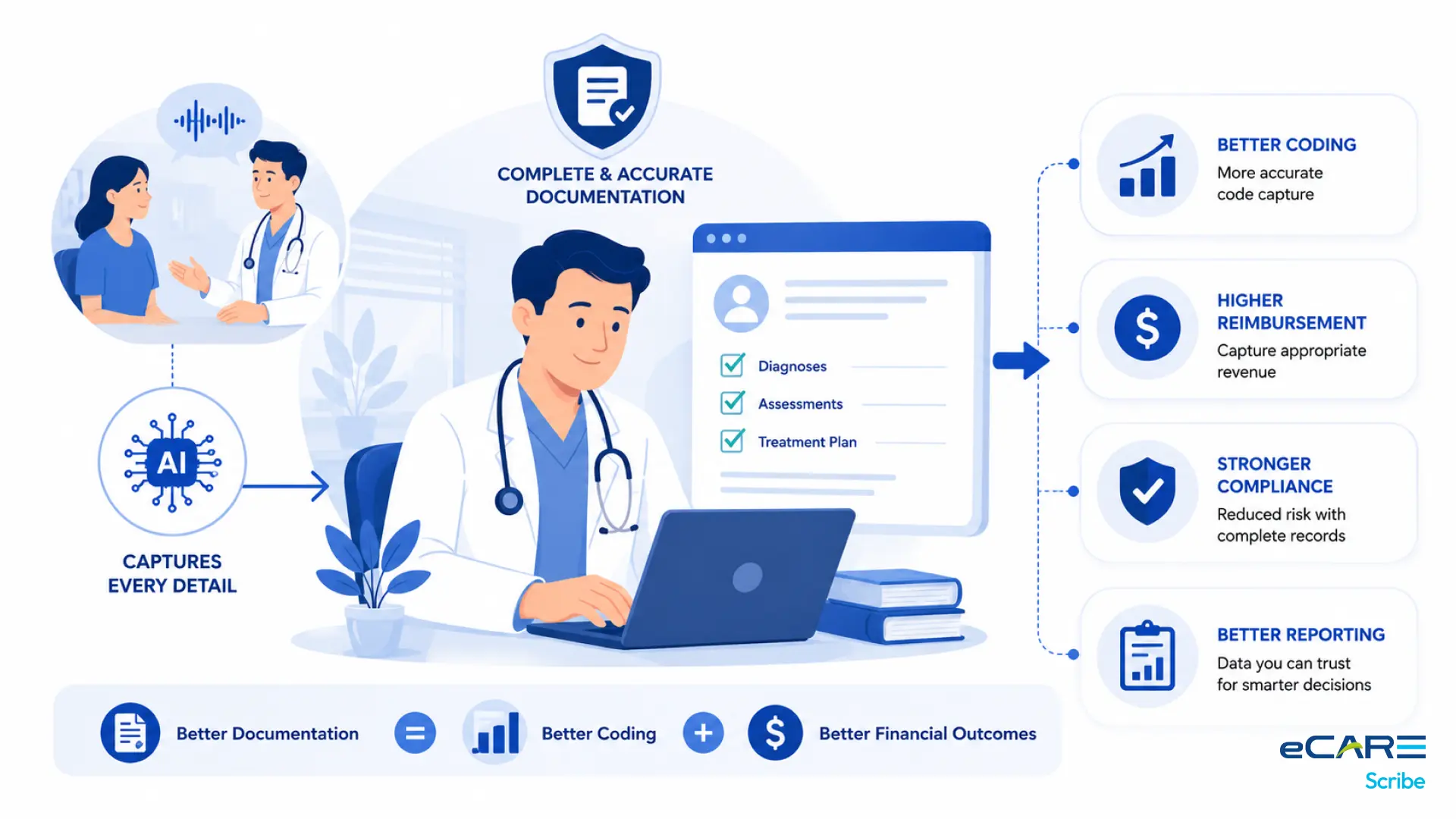
Documentation quality has a direct impact on coding accuracy, reimbursement, and compliance. However, in busy clinical environments, providers often have limited time to create detailed notes, which can result in missing information, incomplete records, or documentation gaps.
Ambient AI scribes help address this challenge by capturing clinical conversations in real time and generating comprehensive encounter notes. With less time spent recalling details after a visit, providers can review documentation that more accurately reflects the care delivered.
This matters because accurate documentation supports accurate coding. When diagnoses, assessments, and treatment plans are clearly documented, healthcare organizations are better positioned to support reimbursement, quality reporting, and risk adjustment initiatives.
To measure the impact of this ROI lever, organizations should track metrics such as documentation completeness, coding accuracy, claim denial rates, and reimbursement trends. Even small improvements in these areas can create meaningful value over time.
The benefits extend beyond financial performance. Better documentation supports care continuity, strengthens compliance efforts, and creates a more reliable clinical record—helping both providers and patients in the long run.
Total Economic Impact: A 36-Month Projection
If you're building a business case for an ambient AI scribe, it's important to look beyond the first few months. The biggest gains often don't show up immediately—they build over time.
In the beginning, you'll likely notice the obvious benefits: providers spend less time documenting, notes are completed faster, and after-hours charting starts to decrease. But as those improvements become part of everyday workflows, other benefits begin to emerge. Providers feel less burdened by documentation, patient schedules become easier to manage, and clinical records become more consistent and complete.
That's why many healthcare organizations evaluate AI scribe ROI over a multi-year period rather than a single quarter. The goal isn't simply to save time. It's to create a more efficient clinical environment where providers can focus more on patient care and less on administrative work.
When you look at clinician satisfaction, operational efficiency, documentation quality, and patient access together, the long-term value becomes much easier to understand. Individually, these improvements may seem small. Collectively, they can have a meaningful impact on how a healthcare organization operates and grows.
Conclusion
At its core, the ROI of an ambient AI scribe isn't really about technology—it's about people.
It's about giving providers more time to focus on patients instead of paperwork. It's about reducing the frustration that comes from hours of documentation after clinic hours. And it's about helping healthcare organizations create workflows that are more efficient, sustainable, and supportive of the people delivering care.
As you evaluate the business impact of an AI scribe, avoid focusing on a single metric. The greatest value often comes from the combination of improved provider experience, stronger documentation, better operational performance, and enhanced patient care.
The organizations seeing the strongest results today are not simply adopting AI. They're using it to solve real clinical and operational challenges—and that's where meaningful ROI begins.
Frequently Asked Questions
How long does a typical eCareScribe deployment take?
For most ambulatory practices and specialty clinics, a sensible first deployment runs 30 to 60 days from kickoff to first measurable result. The variables that move that timeline are the depth of integration required, the breadth of pilot users in week one, and the cadence of configuration review.
What is the realistic ROI window?
The earliest meaningful ROI signal is at day 30 to 45 — typically a workflow time metric that moves first. The financial ROI signal usually appears between month 3 and month 6, depending on which baseline KPIs you set at kickoff.
How does eCareScribe handle change management?
The change management problem is rarely about the tooling — it is about workflow design. eCareScribe deployments succeed when the leadership team owns the workflow change story and the vendor team owns the configuration.
What integration depth does eCareScribe require?
Most ambulatory practices and specialty clinics run a heterogeneous stack assembled over many years. eCareScribe integrates at the depth required by each system and exposes structured APIs for downstream tooling.
How do I evaluate eCareScribe against alternatives?
Score each vendor on five axes: workflow fit, integration depth, configuration flexibility, support quality, and pricing transparency. Insist on a 30-day live pilot before signing a multi-year commitment.