
Behavioral Health Practice Doubles Therapist Session Capacity

The client was facing five resignations, all from their senior therapists, because of the after-hours charting and burnout. They wanted a solution within 90 days to make sure the therapists got their personal time back.
Business Challenges
The trigger was a resignation letter. Karen Whitfield — a senior trauma therapist who had been with Lakeshore Behavioral the longest — walked into the practice owner's office on a Friday afternoon in March, handed in a 90-day notice, and explained in plain language why. She had taken on 18 months of pajama-time charting, and her partner had asked her to choose between Lakeshore and her marriage. She chose her marriage. She gave the practice 90 days to either fix it or replace her.
The practice owner spent the weekend talking to four other senior therapists. Three of them said they were within six months of making the same call. By Monday morning, the conversation inside Lakeshore had shifted from "how do we manage therapist burnout" to "we are about to lose half our senior clinical bench inside a year."
What made the situation specifically hard was the texture of the work. Lakeshore's caseload skewed heavily toward trauma-informed CBT and EMDR — modalities that produce dense, idiosyncratic progress notes.
The CPT 90837 sessions that paid the bills also produced the most documentation per encounter. As caseloads grew through the post-pandemic mental health surge, the therapist-side ratio of charting-to-billing hit roughly 1:2 — for every two hours billed, one hour of unpaid charting had to happen somewhere. Senior therapists were absorbing it after dinner.
- One senior therapist with 16 years of tenure had given written 90-day notice; three more had verbally indicated they were near the same decision.
- Average after-session charting time across the practice was running 2 hours 24 minutes per therapist per day, almost entirely off-hours.
- Therapist-reported burnout score on the most recent annual survey was 78%, with documentation cited as the top contributing factor on 64% of responses.
- DSM-5 progress notes were structurally inconsistent; an external coder review had flagged 14% of the submitted 90837 claims as documentation-deficient under payer audit standards.
- Therapists were declining new evening intake slots to preserve personal time, leaving roughly 320 patient appointments per quarter unfilled at the practice level.
Solution
The evaluation conversation started somewhere unusual: not with a vendor demo, but with a question Karen asked during her exit-planning conversation. She said: "If you can show me a tool that writes a real DSM-5 progress note from the session itself — not a checkbox or a template I have to retrofit — I will stay. Anything less and I'm out."
That framing shaped the evaluation. The practice owner ruled out anything that required the therapist to do post-session editing of more than five minutes. She also ruled out anything that produced notes that could not pass an external coder review unmodified. Those were the two gates.
eCareScribe was selected after a working session in which Lakeshore's clinical lead sat with eCareScribe's behavioral-health configuration team and walked through three real EMDR session recordings (with consented redaction). The eCareScribe team did not present a template. They asked the clinical lead what a good progress note for an EMDR session needed to contain, for clinical continuity, for billing, and for malpractice defensibility, and built a configuration against that. The clinical lead left the working session with a written specification she could defend to her therapists.
Value Delivered
Karen rescinded her notice 47 days into the pilot. So did the three therapists who had been considering the same exit. None of the rescissions were the result of a leadership conversation — they were the result of the therapists themselves, individually and unprompted, telling the practice owner that the documentation problem they had been quietly dying under had been solved. That was the headline outcome the practice owner had not allowed herself to plan for.
- 5/5 resignation-considering therapists retained — including the original 90-day notice that triggered the engagement.
- 2:24 → 0:11 average after-session charting time — measured in week 8 of the pilot across all 5 pilot therapists.
- 96.4% pass rate on external coder audit of DSM-5 progress notes generated by eCareScribe (vs 86% on therapist-written prior baseline).
- 320 → 0 unfilled evening intake slots per quarter as therapists reopened their personal capacity once charting was off their evenings.
- $2.1M annualized revenue lift from recovered intake capacity plus reduced agency-coverage spend on resignations that did not occur.
Solution Provided
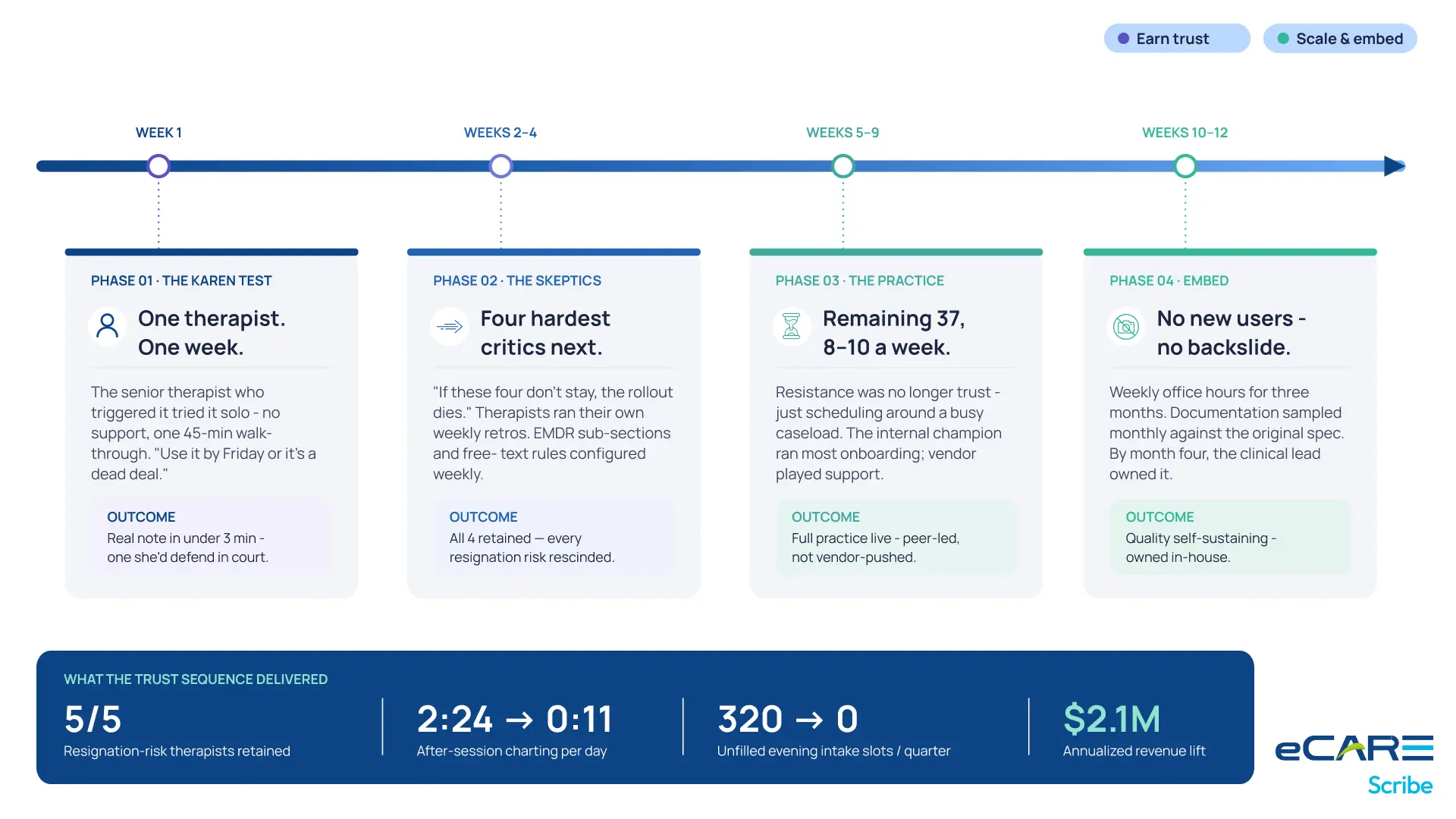
The rollout was not phased by location or by user group in the usual way. It was phased by trust.
Week 1: The Karen Test
Before anyone else touched the system, Karen got it. She used it for one full week with no support, no instructions beyond a 45-minute walkthrough, and the explicit understanding that if she wasn't using it by Friday, it was a dead deal. She used it. On Friday, she wrote a one-page memo to the practice owner: "This is the first time in five years I have written a real progress note in under three minutes that I'd be proud to defend in court."
Weeks 2–4: The Skeptics
The four other resignation-leaning therapists came onto the system next. The practice owner picked them deliberately because they were the hardest critics. The instruction to eCareScribe's deployment team was: "If these four don't stay, the rollout dies." Weekly retros were run by the therapists themselves, not by the vendor. Issues surfaced — the EMDR-specific structure needed a sub-section for bilateral stimulation parameters, the trauma-history narrative needed a longer free-text allowance — and were configured before the next week.
Weeks 5–9: The Practice
The remaining 37 therapists came on in groups of 8–10 per week. By this point, the resistance was no longer "I don't trust the AI." It was logistical: scheduling training time during a busy caseload. Karen, who had become the internal champion, did most of the new-user onboarding herself. eCareScribe's team played a supporting role.
Weeks 10–12: Embed
The final phase wasn't about adding users — it was about ensuring the practice didn't backslide. eCareScribe stayed engaged through weekly office hours for the first three months. Documentation quality was sampled monthly against the original specification. By month four, the practice's clinical lead had taken over the sampling cadence herself.
Business Value
The financial case for the engagement was clear by month two — the saved senior-therapist replacement cost alone exceeded the implementation investment by roughly $640K. But the practice owner's view of the business value extended further than the spreadsheet, and it became the basis for a conversation she has had with peer behavioral-health practice owners six or seven times since.
What the practice actually preserved
Five senior therapists represented 84 years of combined clinical tenure at Lakeshore. The institutional knowledge — referral networks, supervision relationships, treatment-modality expertise, and the practice's reputation in trauma work — was not replaceable in any meaningful timeframe. eCareScribe preserved that. The dollar figure on retained revenue understates what was actually at stake.
What changed about the practice's growth thesis
For three years, the practice owner had been hiring against an attrition curve. New therapists were added to replace exits, not to grow. Once the resignation pipeline closed, the next hiring cohort became a growth investment. The practice opened a second location 11 months after the engagement closed — a possibility that had been off the table the year before.
The lesson the practice owner brings to peer conversations
"We almost made the wrong decision," the practice owner has said. "I was three weeks away from telling the partners we needed to raise rates 12% to fund replacement hiring. That would have changed our patient mix and our reputation in a way I would have spent a decade undoing. The expensive thing was not the platform. The expensive thing was almost not buying it."