

Get Started Now
eclinicalworks logo
Epic logo
cerner logo
athenahealth logo
advancedmd logo
eclinicalworks logo
Epic logo
athenahealth logo
advancedmd logo

eCareScribe’s Core Capabilities as Autonomous Medical Coding Software

Built for Coding Accuracy & Compliance icon

Built for Coding Accuracy & Compliance

Designed to align with ICD-10, CPT, and HCPCS guidelines, helping reduce errors and maintain consistent, compliant coding practices.

Real-Time Documentation Alignment icon

Real-Time Documentation Alignment

Analyzes clinical documentation to ensure codes accurately reflect patient encounters, reducing discrepancies and audit risks.

Seamless Integration with RCM Workflows icon

Seamless Integration with RCM Workflows

Integrates with revenue cycle management and EHR platforms to ensure smooth data flow from documentation to claim submission.

Denial Prevention by Design icon

Denial Prevention by Design

Reduce errors before claims are submitted. Identifies potential coding issues early, helping prevent claim denials and improving clean claim rates.

Scalable Coding Efficiency icon

Scalable Coding Efficiency

Automates repetitive coding tasks, enabling teams to manage growing workloads while maintaining accuracy and consistency.
Exclusive Features of eCareScribe’s AI Medical Coder

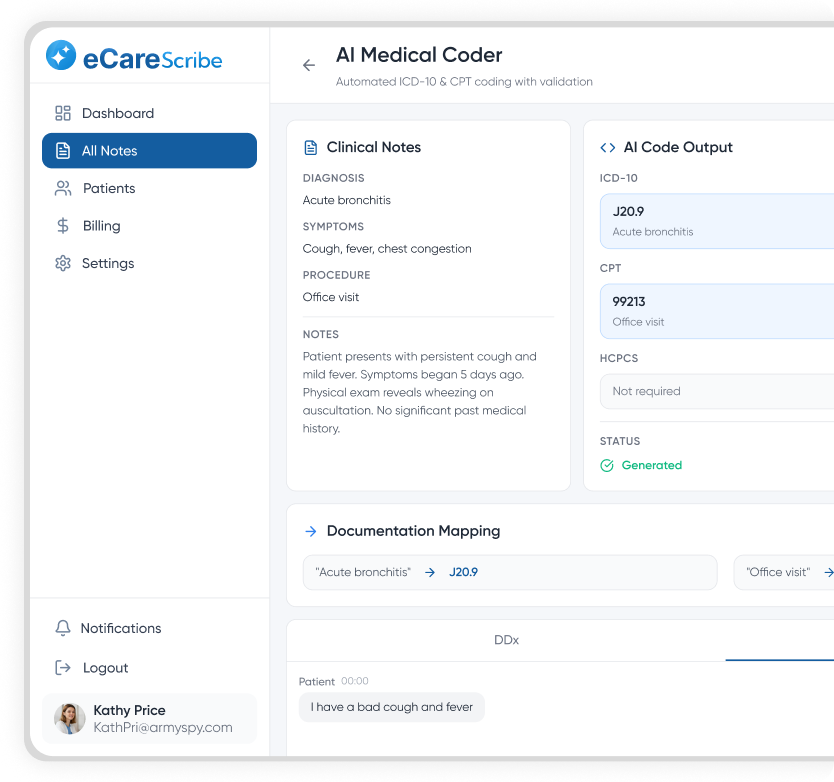
Automated ICD-10 & CPT Code Generation image

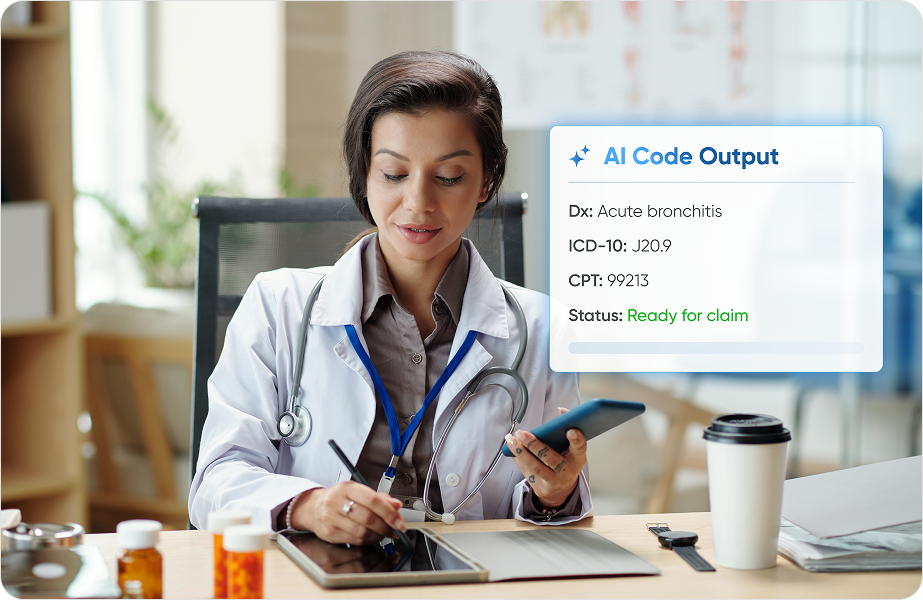
Automated ICD-10 & CPT Code Generation

1. Extract insights from clinical documentation

Analyze provider notes, diagnoses, and procedures to identify all relevant coding elements from each patient encounter.

2. Generate accurate ICD-10 and CPT codes

Automatically assign appropriate diagnosis and procedure codes based on clinical context and documentation.

3. Improve coding speed and consistency

Reduce manual effort while ensuring standardized and consistent code generation across all encounters.
Real-Time Coding Validation & Error Detection image

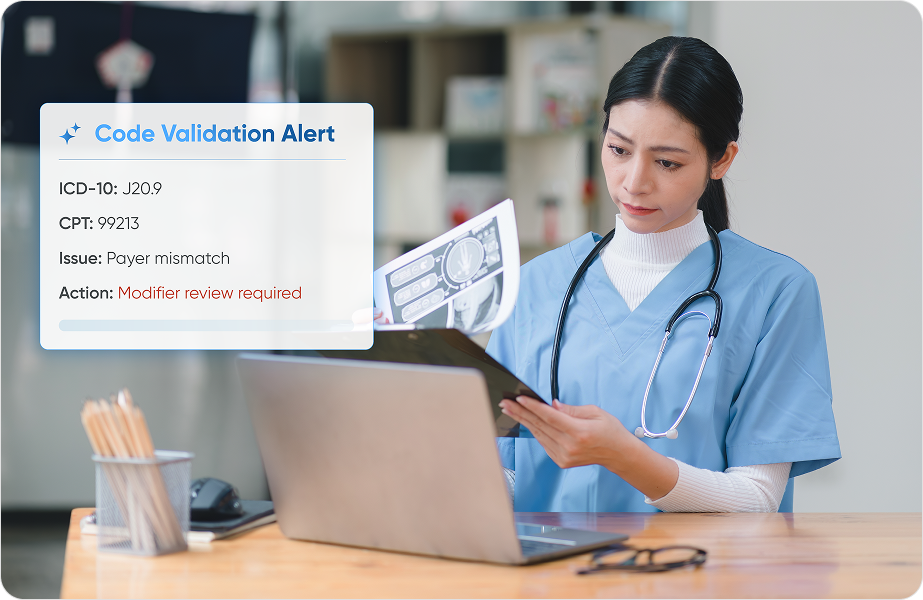
Real-Time Coding Validation & Error Detection

1. Validate codes against payer guidelines

Check assigned codes in real time against payer rules and compliance requirements.

2. Detect coding errors and mismatches

Identify missing, incorrect, or inconsistent codes before claims are submitted.

3. Ensure clean and compliant claims

Improve claim accuracy by resolving issues early in the coding workflow.
Documentation-to-Code Mapping image

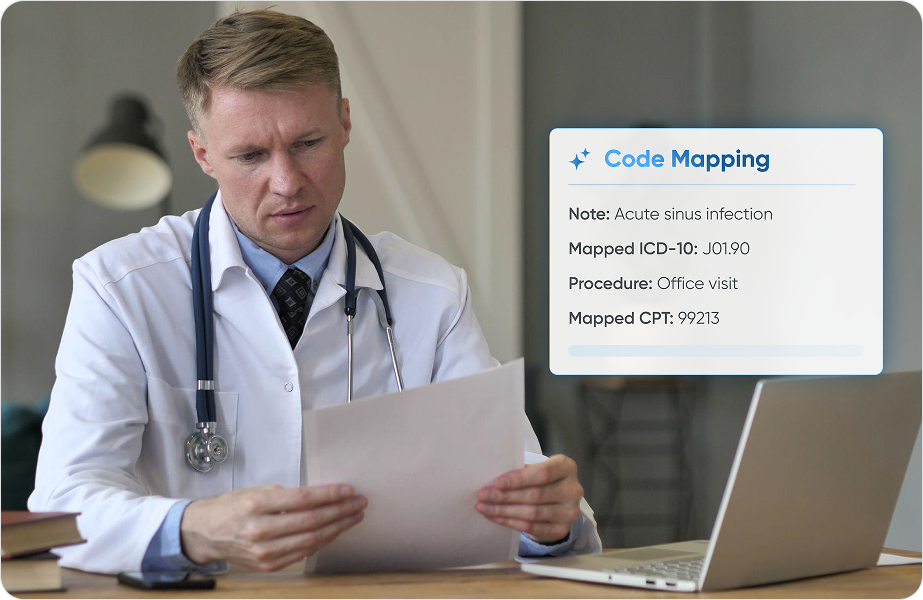
Documentation-to-Code Mapping

1. Align codes with clinical documentation

Ensure every assigned code accurately reflects the patient encounter and provider notes.

2. Reduce audit and compliance risks

Maintain clear traceability between documentation and codes to support audits.

3. Prevent undercoding and overcoding

Ensure complete and precise coding to capture the full scope of care delivered.

Denial Risk Identification & Optimization image

Denial Risk Identification & Optimization

1. Identify potential denial triggers early

Analyze coding patterns and flag issues that may lead to claim rejection.

2. Optimize claims before submission

Refine codes and documentation alignment to improve acceptance rates.

3. Accelerate reimbursement cycles

Submit cleaner claims that are processed faster with fewer reworks.
Case Studies

3 Jan,2025

Enhanced Provider Efficiency with the Implementation of eCareScribe: A Case Study

The client, a multispecialty network of hospitals, is deeply committed to providing high-quality care to patients...
3 Jan,2025

Enhancing Efficiency and Care with eCareScribe AI Notetaker: A Case Study

The client is a psychology specialty focusing on mental and behavioral health care for individuals, couples...

3 Jan,2025

How eCareScribe Software Boosted Practice Revenue and Streamlined Patient Care: A Success Story

The client is a cardiovascular specialty practice located in Michigan, United States. Since 2012, the practice...
3 Jan,2025

How eCareScribe Transformed Operations and Enhanced Patient Care: A Case Study

The client, a primary care hospital in Florida, is dedicated to managing over 800 patients monthly.

...

Try eCareScribe’s AI Medical Coding Software Today!

Get your 1 week free trial, with easy opt out
FAQ

AI medical coding software uses advanced algorithms to analyze clinical documentation and automatically generate diagnosis and procedure codes. As an AI medical coder, it leverages automated ICD-10 coding software and CPT code automation software to assign accurate codes based on patient encounters, reducing manual effort and improving consistency.

Medical coding validation software uses real-time coding error detection software to analyze assigned codes against payer rules and clinical documentation. It identifies missing, incorrect, or inconsistent codes early, helping prevent errors before claims are submitted.

Documentation-to-code mapping software links clinical notes directly to assigned codes, ensuring that each diagnosis and procedure is accurately represented. This process, powered by clinical documentation coding software, improves transparency, audit readiness, and coding accuracy.

Using claim denial risk identification software and medical coding denial prevention software, the system analyzes coding patterns and flags potential issues that could lead to claim rejection. This allows teams to correct errors early and submit cleaner claims.

While autonomous medical coding software can automate a significant portion of the coding process, human oversight remains important. A medical coder AI works best as a support system that improves efficiency and accuracy while allowing coders to review and validate final outputs.

Modern ICD-10 CPT code generation software can achieve high levels of accuracy by analyzing large datasets and clinical patterns. Compared to manual coding, medical coding accuracy software reduces variability and helps ensure consistent, high-quality coding outcomes.

Yes, most AI medical coding software solutions are built with strict security protocols to ensure compliance with healthcare regulations. They protect sensitive patient data and maintain secure handling throughout the coding and billing process.

AI coding systems integrate seamlessly with EHR and billing platforms, enabling real-time data exchange. As part of computer assisted coding software, they connect clinical documentation with billing workflows to streamline end-to-end revenue cycle processes.

Hospitals, clinics, specialty practices, and large healthcare systems benefit from AI medical coder solutions. Whether using clinical documentation coding software or automation tools, organizations of all sizes can improve efficiency, accuracy, and revenue outcomes.

Medical coding validation software helps prevent common issues such as missing codes, incorrect code selection, mismatched documentation, and non-compliant coding. With real-time coding error detection software, these errors are identified early, reducing rework and claim denials.
 

Budapest is the capital city of Hungary. It is best known for its arts and culture. It is a relatively small city, however there are much to see and do. ...


Barcelona, framed for its individuality, cultural interest, and physical beauty, home to art and architecture. Facing the Mediterranean to the southeast, ...

Barcelona, framed for its individuality, cultural interest, and physical beauty, home to art and architecture. Facing the Mediterranean to the southeast, ...